

The soreness you’re feeling two days after a crash isn’t proof that you’re fine. It’s often the first sign that something went wrong and your body is only now catching up.
After a collision, your nervous system floods with adrenaline. That response is protective in the moment. It’s also the reason so many people walk away from an accident feeling okay, spend a few days waiting it out, and then find themselves unable to turn their head by day four. The injury was always there. The signal just got delayed.
Direct Answer
Seeing an auto accident chiropractor promptly after a collision matters because whiplash and soft tissue injuries often don’t produce full symptoms for 24 to 72 hours. Early evaluation helps identify musculoskeletal injuries before they stiffen into chronic problems. Chiropractic care, once serious injuries are ruled out, can support natural recovery through movement, spinal assessment, and individualized rehabilitation.
Key Takeaways
- Symptoms like neck pain, stiffness, and headaches can appear hours or days after impact, not immediately at the scene
- Certain warning signs (neurological symptoms, severe headache, confusion, weakness) require emergency medical evaluation before any chiropractic care
- Untreated soft tissue injuries don’t simply resolve on their own; they tend to develop into restricted movement and chronic pain patterns
- A chiropractor evaluates musculoskeletal complaints after serious injuries have been ruled out, not instead of that ruling
- Getting assessed early gives you more recovery options; waiting narrows them
What Actually Happens to Your Body in a Collision?
A car accident doesn’t have to be severe to cause real injury. Even a low-speed rear-end collision generates enough force to snap your head forward and back faster than your muscles can brace. That’s whiplash, and it’s not a minor inconvenience.
Whiplash is a soft tissue injury affecting the muscles, ligaments, and joints of the cervical spine (neck). It’s defined by a rapid, forced movement of the head beyond its normal range, causing strain to the structures that support it.
Common injuries after a collision include:
- Neck muscle strain and ligament sprains
- Reduced range of motion in the cervical spine
- Upper back and shoulder tension from bracing impact
- Headaches originating from the base of the skull
- Lower back pain from seat compression and torso strain
- Joint discomfort in the shoulders, hips, or knees from bracing or impact
The force doesn’t have to be dramatic. The angle, the position of your head at impact, and whether you saw the collision coming all change how your body absorbs it.
Why Do Symptoms Show Up Days Later?
This is the question most people don’t think to ask until they’re already stiff and wondering what happened.
The delay isn’t unusual. It’s how soft tissue injury works.
When ligaments and muscles are strained, the initial inflammatory response takes time to build. Swelling, tightening, and nerve irritation don’t always peak immediately. Adrenaline suppresses pain signals during and after the event. By the time your body settles and the protective response fades, the underlying injury is fully expressing itself.
A typical scenario: someone walks away from a rear-end collision feeling shaken but okay. They go to work the next day with mild stiffness. By day three, they can’t rotate their neck comfortably, they’re waking up with headaches, and their upper back feels locked. Nothing “happened” between the accident and day three. The injury was there the whole time.
This is exactly why prompt evaluation matters, even when you feel relatively fine at the scene. Waiting to see if symptoms develop gives those symptoms time to become entrenched. You can read more about why waiting for pain to resolve on its own is rarely the safe option it feels like.
Red Flags That Require Emergency Medical Attention First
Before any conversation about chiropractic care, this needs to be stated plainly: some symptoms after a car accident require emergency evaluation, not a chiropractic appointment.
Go to an emergency room or call 911 if you experience:
- Severe or sudden-onset headache unlike anything you’ve felt before
- Confusion, disorientation, or difficulty staying awake
- Numbness, tingling, or weakness in your arms or legs
- Loss of bladder or bowel control
- Visible deformity or suspected fracture
- Chest pain or difficulty breathing
- Loss of consciousness at any point, even briefly
These are neurological and structural warning signs. They suggest possible spinal cord involvement, traumatic brain injury, or internal injury. Chiropractic care is not appropriate until those conditions have been ruled out by emergency medical staff.
Once serious injury is cleared, that’s when a musculoskeletal evaluation becomes the right next step.
What a Chiropractor Actually Evaluates After an Accident
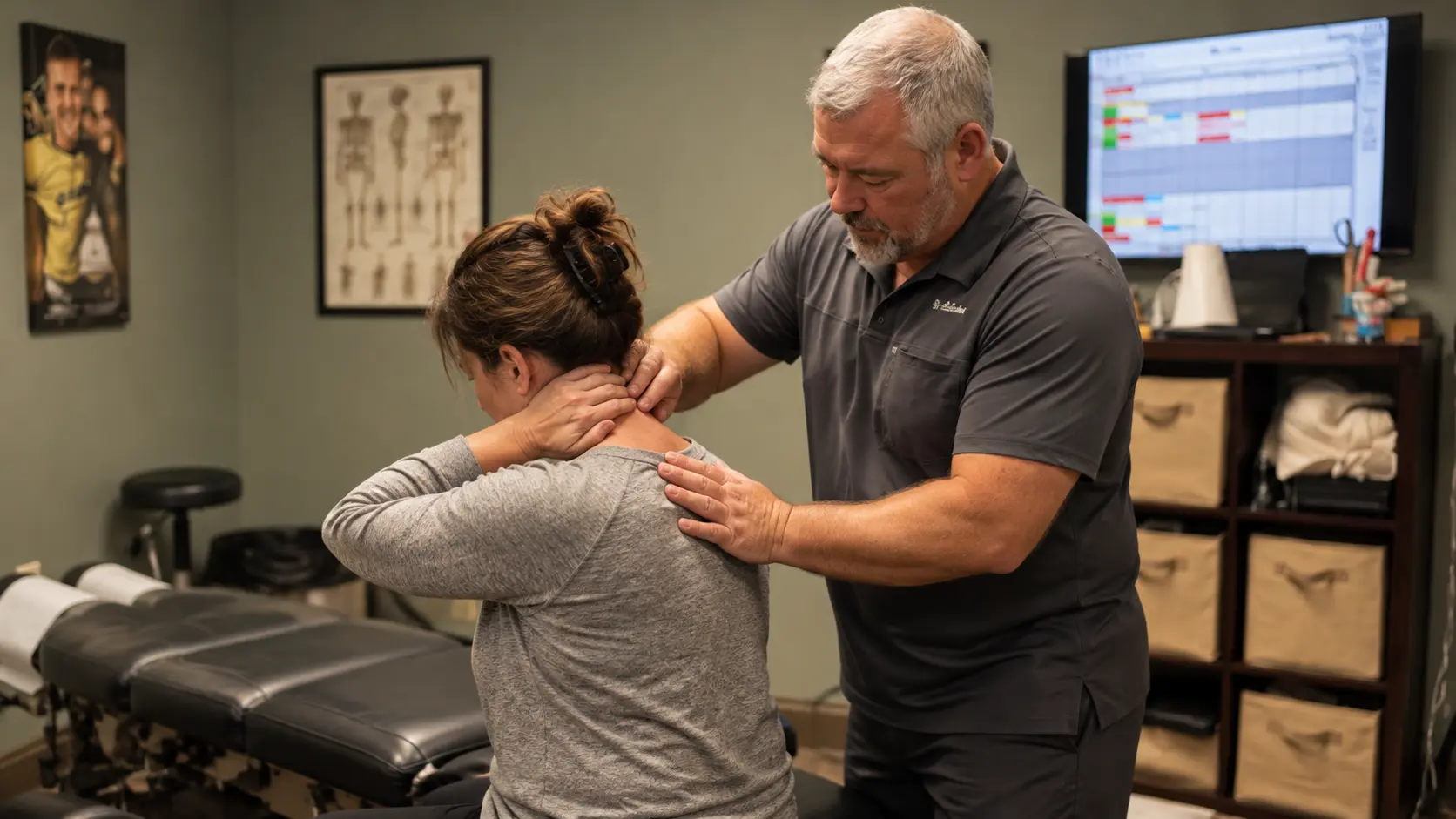
This is where most people have the wrong picture. A chiropractic evaluation after a car accident isn’t just “cracking your back.” It’s a structured assessment of how your spine, joints, and soft tissues are functioning after trauma.
A chiropractor looks at:
- Cervical and lumbar range of motion compared to normal baselines
- Postural changes that developed as a protective response to pain
- Joint mobility restrictions in the neck, mid-back, and lower back
- Muscle tension patterns that signal guarding or compensation
- Neurological screening to identify nerve involvement
The goal of that evaluation isn’t to start treatment immediately. It’s to understand what’s actually happening so that the approach fits the specific injury, not a generic protocol.
At McCracken Chiropractic, the focus is on identifying the underlying cause of your discomfort, not just managing the symptom that brought you in. That’s a different starting point than most people expect from a first visit.
If you’re trying to understand what to look for in a provider, this guide on what to know before choosing a chiropractor in Calhoun, GA walks through the questions worth asking.
The Contrarian Truth About “Mild” Accidents
Here’s what most people get wrong: the severity of the crash doesn’t predict the severity of the injury.
A slow-speed collision where the car barely shows damage can still cause significant soft tissue trauma. The reason is physics. A rigid vehicle absorbs and transfers force differently than a human spine. When bumpers don’t crumple, more of that energy goes directly into the occupants.
People who brace for impact often sustain more muscle strain than those who didn’t see it coming, because the tensed muscles absorb force differently. That’s not intuitive. It runs against the assumption that being prepared protects you.
The real cost of waiting isn’t the original injury. It’s the chain reaction that follows.
Untreated soft tissue injuries don’t simply rest and recover. They adapt. Muscles tighten to protect injured joints. Posture shifts to reduce pain. Movement patterns change. Over weeks and months, what started as a neck strain can become a chronic headache pattern, a shoulder mobility problem, or recurring upper back tension. The body is solving a short-term problem by creating a long-term one.
What Recovery Actually Looks Like With Chiropractic Care
Conservative, individualized care after a car accident typically involves several elements working together:
Spinal assessment and gentle adjustments to restore joint mobility that was restricted by the impact or by protective muscle guarding afterward.
Soft tissue work to address the muscle tension and trigger points that develop as the body braces around an injury.
Corrective movement and rehabilitation exercises to rebuild strength and stability in the affected area without reinjuring it.
Progress monitoring to adjust the approach as the injury responds.
What this doesn’t look like is a fixed number of visits prescribed on day one. A real recovery plan responds to how your body is actually healing, not a predetermined schedule.
The services available at McCracken Chiropractic are designed around that kind of individualized approach, which matters more after trauma than in almost any other context.
For patients wondering whether chiropractic care is the right fit for their specific situation, this honest breakdown of whether chiropractic care actually works and what has to happen first is worth reading before your first appointment.
The Post-Accident Decision Framework: A Simple Way to Think About Timing
Call this the “3-Day Window Assessment.” It’s not a diagnostic tool. It’s a decision guide for knowing when to act.
Use it when you’re unsure whether your symptoms after an accident are serious enough to warrant evaluation.
Day 0 to 1 (immediately after the accident): Any of the red flag symptoms listed above? Emergency care, no delay.
Day 1 to 3 (symptoms developing or worsening): Neck stiffness, headaches, shoulder tension, reduced range of motion, or back pain appearing or intensifying? This is the window where early evaluation has the most impact on recovery trajectory.
Day 3 and beyond (symptoms persisting or spreading): If you’ve been waiting and symptoms haven’t resolved, the window hasn’t closed, but the recovery path is likely longer. Earlier is always better. Later is still better than never.
The 3-Day Window Assessment works because it removes the “let me see how I feel” delay that most people use as a reason to wait. That delay has a real cost.
If you’re also weighing whether to try pain medication or other options while you wait, this comparison of chiropractic care versus pain medication versus surgery for neck pain lays out the tradeoffs honestly.
Acting Now vs. Waiting: What the Decision Actually Costs You
| Decision | Short-Term Experience | Long-Term Risk |
|---|---|---|
| Early evaluation (within 72 hours) | One appointment, clear picture of injury status | More recovery options, faster return to normal function |
| Waiting a week or two | Feels lower-effort, no immediate cost | Soft tissue stiffening, compensation patterns developing |
| Waiting until pain becomes severe | Avoids “unnecessary” appointments | Injury may be entrenched, recovery timeline longer |
| Skipping evaluation entirely | No upfront time or cost | Chronic pain patterns, restricted mobility, potential for recurring symptoms |
The table above doesn’t show McCracken Chiropractic as the expensive option. It shows inaction as the expensive option. That’s the accurate framing.
If you’re in or near Calhoun and you’ve been in a collision recently, the right move is a conversation, not a commitment. Request an appointment at McCracken Chiropractic and get a clear picture of what’s actually happening before symptoms have a chance to settle in.
Who This Approach Isn’t Right For
Honest care means saying this plainly.
Chiropractic evaluation after a car accident isn’t appropriate if you have unresolved emergency symptoms, suspected fracture, or neurological signs that haven’t been cleared by a medical provider. Those need emergency attention first, without exception.
It’s also not a replacement for imaging when imaging is warranted. If your emergency evaluation identified a structural concern, that information needs to be part of any chiropractic assessment.
And if you’re looking for a guaranteed outcome or a fixed timeline, that’s not something any honest provider can offer. What McCracken Chiropractic can offer is a thorough evaluation, a personalized plan, and care that adjusts as your body responds. That’s a realistic promise, not an inflated one.
Frequently Asked Questions
How soon after a car accident should I see a chiropractor?
Within 72 hours is the general window where early evaluation has the most impact, assuming no emergency symptoms are present. The sooner soft tissue injuries are assessed, the more options you have for recovery. Waiting until symptoms become severe doesn’t make the injury more treatable; it usually makes it harder to address.
What if I feel fine right after the accident?
Feeling fine at the scene is common and doesn’t mean you’re uninjured. Adrenaline suppresses pain signals during and immediately after a collision. Symptoms like neck stiffness, headaches, and reduced range of motion often appear 24 to 72 hours later. Getting evaluated while you feel okay is smarter than waiting until you don’t.
Can a chiropractor treat whiplash?
A chiropractor can evaluate and address the musculoskeletal components of whiplash, including cervical joint restriction, muscle strain, and postural changes, once serious injuries like fractures or spinal cord involvement have been ruled out. Chiropractic care isn’t a treatment for every injury a collision can cause, but it’s well-suited for the soft tissue and joint issues that whiplash typically involves.
What’s the difference between seeing a chiropractor and just resting after an accident?
Rest addresses pain in the short term by reducing demand on injured tissue. It doesn’t restore joint mobility, address muscle compensation patterns, or identify underlying structural issues. Injuries that are rested but not evaluated often develop into chronic problems because the body adapts around the dysfunction rather than resolving it.
Do I need a referral to see a chiropractor after a car accident?
In most cases, no. You can schedule directly. If you have emergency symptoms or your primary care provider has identified a specific concern, that information is worth sharing with the chiropractor at your first visit so it can be factored into the evaluation.
Will chiropractic care interfere with my insurance or legal claim?
Getting evaluated and treated for legitimate injuries after a collision is consistent with protecting both your health and your claim. Documented care creates a record of your injuries and treatment. Gaps in care, on the other hand, can be used to argue that your injuries weren’t serious. Consult with your insurance provider or attorney about the specifics of your situation.
What if my symptoms have already been present for several weeks?
The window for early intervention has passed, but that doesn’t mean care isn’t worth pursuing. Chronic soft tissue restrictions and compensation patterns that developed after an accident can still be addressed. The recovery timeline may be longer, but doing nothing at that point doesn’t improve the outcome.
The body you have after an accident isn’t the same one you had before it. Getting it evaluated isn’t overcautious. It’s the only way to know what you’re actually dealing with before it becomes something harder to fix.
Contact McCracken Chiropractic in Calhoun, GA to schedule your evaluation and find out exactly where you stand.
About the Author
McCracken Chiropractic is a family-oriented chiropractic practice in Calhoun, GA, specializing in non-surgical, drug-free treatment for pain, injury, and preventative wellness. Led by Dr. Chris McCracken, the practice serves auto accident injury victims, chronic pain patients, and health-conscious families through personalized treatment programs that address the whole person, not just the presenting symptom.


